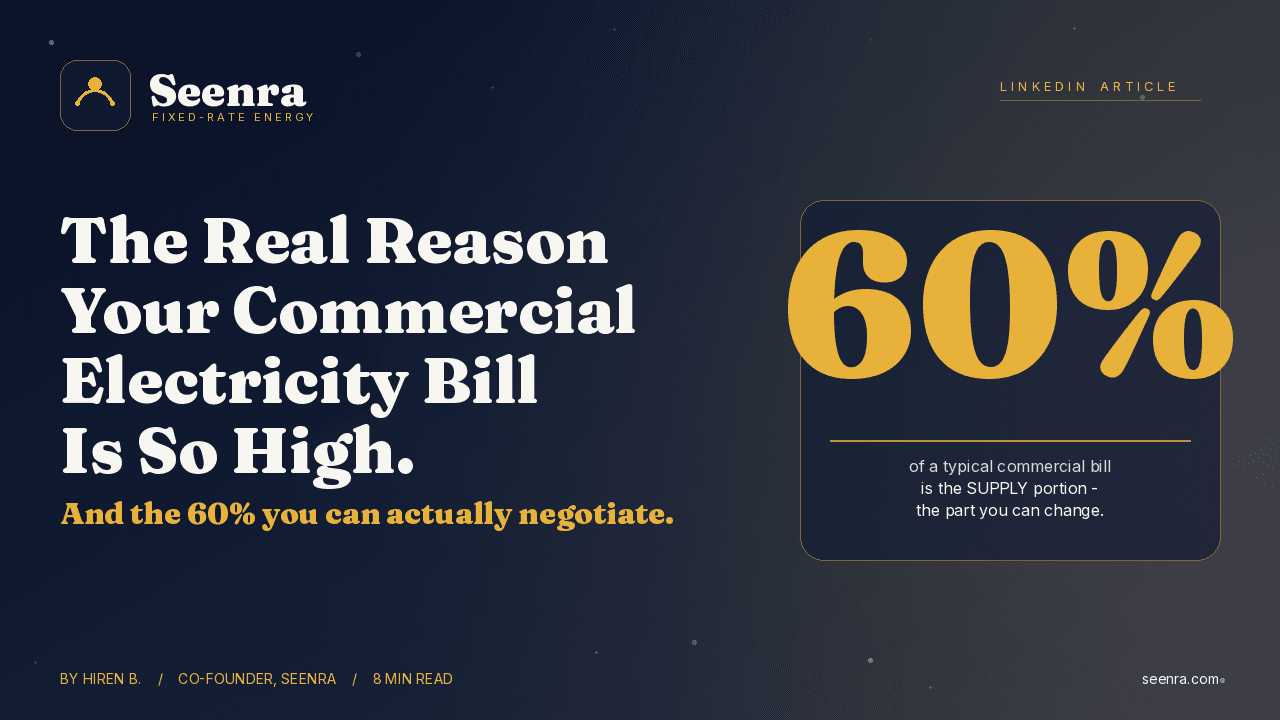
Most U.S. businesses overpay for commercial electricity. Not because rates have gone up - though they have - but because nobody ever explained the bill to them. The result is a quiet, recurring tax on operations that most CFOs and facilities directors have never been told they can do anything about. Here is what is actually on a commercial electricity bill, what is negotiable, what is not, and the one decision that turned a single industrial client's $0.26/kWh utility supply rate into a $0.09/kWh locked contract - and an estimated ~$675,000 a year back on the bottom line.
Anatomy of a U.S. commercial electricity bill
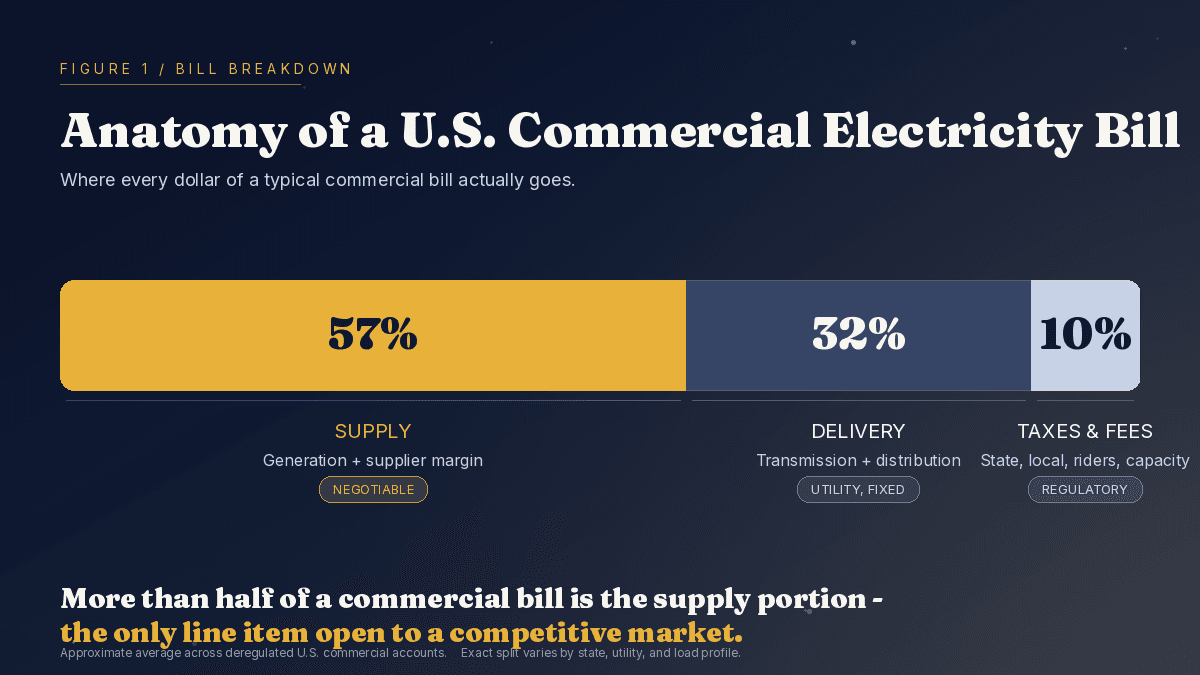
A typical commercial bill in a deregulated U.S. state breaks into three buckets. The exact percentages shift state to state and load to load, but the rough average looks like the figure below.
Supply - roughly 55 to 60 percent of the bill. This is the cost of generating the electricity itself, plus the supplier's margin. In deregulated states, this is open to a competitive market, meaning you can choose who supplies the power and lock the rate by contract.
Delivery - roughly 30 to 35 percent. This is the cost of moving the power from the grid to your meter: transmission lines, distribution wires, substations, transformers. Your local utility owns this infrastructure, and that part of the bill is essentially fixed. There is nothing to negotiate.
Taxes, fees, and riders - roughly 5 to 10 percent. State and local taxes, capacity charges, system benefit funds, demand-side management surcharges. Regulatory. Also fixed.
The headline most buyers miss is simple. The largest single line on the bill is the only line that is open to a market.
Figure
Where every dollar of a typical commercial electricity bill actually goes
Why the utility default supply rate is almost always the most expensive option
When a business does nothing, its electricity supply defaults to the local utility's price-to-compare rate (called PTC, BGS, POLR, or standard offer depending on the state). This is the rate the utility charges anyone who has not picked a competitive supplier.
The price-to-compare has three properties that make it expensive by design. It is recalculated periodically - quarterly, semi-annually, or annually depending on the state - based on wholesale auction results plus the utility's procurement costs and a risk margin. So it floats with the market.
It is built to cover worst-case wholesale spikes, because utilities have to procure for every customer at any point in the cycle, including peak demand periods. So it is priced conservatively. And it carries no contract terms in your favor. No fixed price. No fixed term. No protection from a January cold snap or August heat wave moving the wholesale market 40 percent in a week.
Competitive suppliers can usually offer a lower rate because they only contract with customers who actively choose them, they can hedge specific volumes, and they compete on price for accounts they want to keep.
What a deregulated energy market actually means for your business
About a third of U.S. states have deregulated retail electricity for commercial customers. In those states, the utility is required to deliver power to your meter regardless of who supplies it.
The full deregulated list shifts year to year, but it includes Ohio, Pennsylvania, Texas, Illinois, New York, New Jersey, Maryland, Massachusetts, Connecticut, Rhode Island, Maine, New Hampshire, Delaware, the District of Columbia, and partial deregulation in Michigan, Virginia, and California. For natural gas, the deregulated list is similar but not identical.
If your facility sits in one of these states, you have a legal right to shop the supply portion of your bill. The utility cannot stop you, cannot penalize you, and cannot interrupt service if you switch suppliers. The wires, the meter, the reliability are all unchanged. Only the supply contract changes.
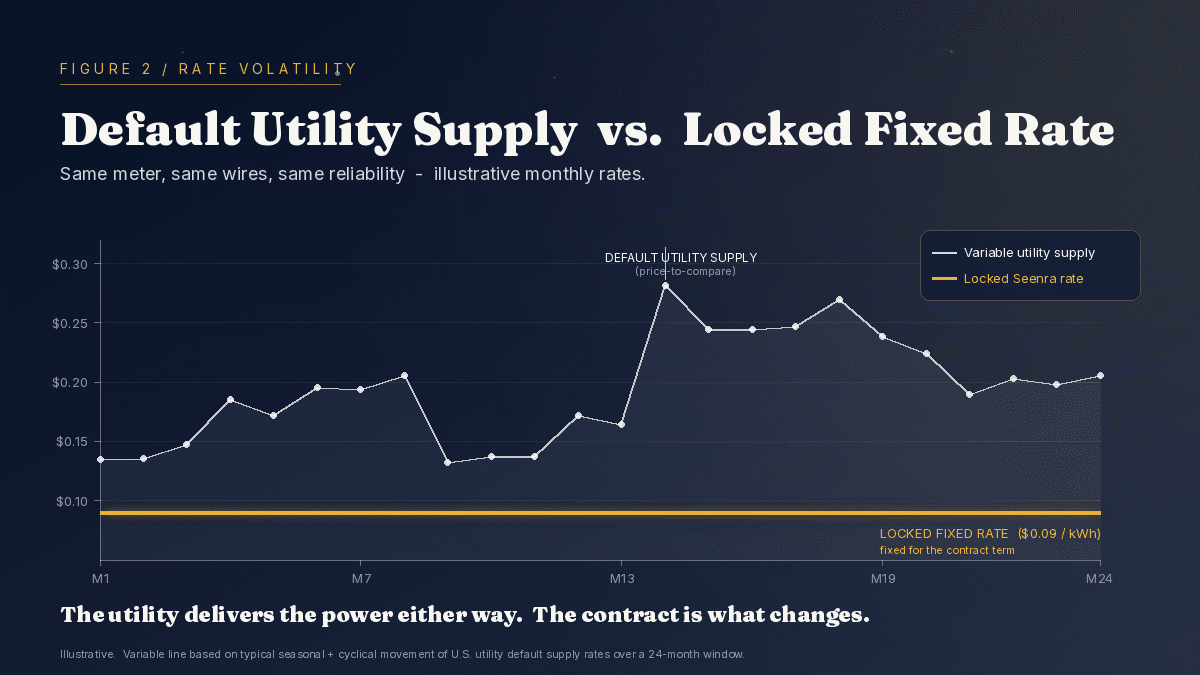
The chart below shows the practical difference. The white line is what a typical commercial account has been paying on the utility's variable default rate over a recent 24-month window - seasonal swings, a sharp spike during a cold-snap month, a slow upward drift. The gold line is what the same account would have paid on a fixed locked rate over the same period. The utility delivers the power either way. The contract is what changes.
Figure
Default utility supply rate vs locked fixed rate over 24 months
A real example: $0.26 to $0.09 per kWh
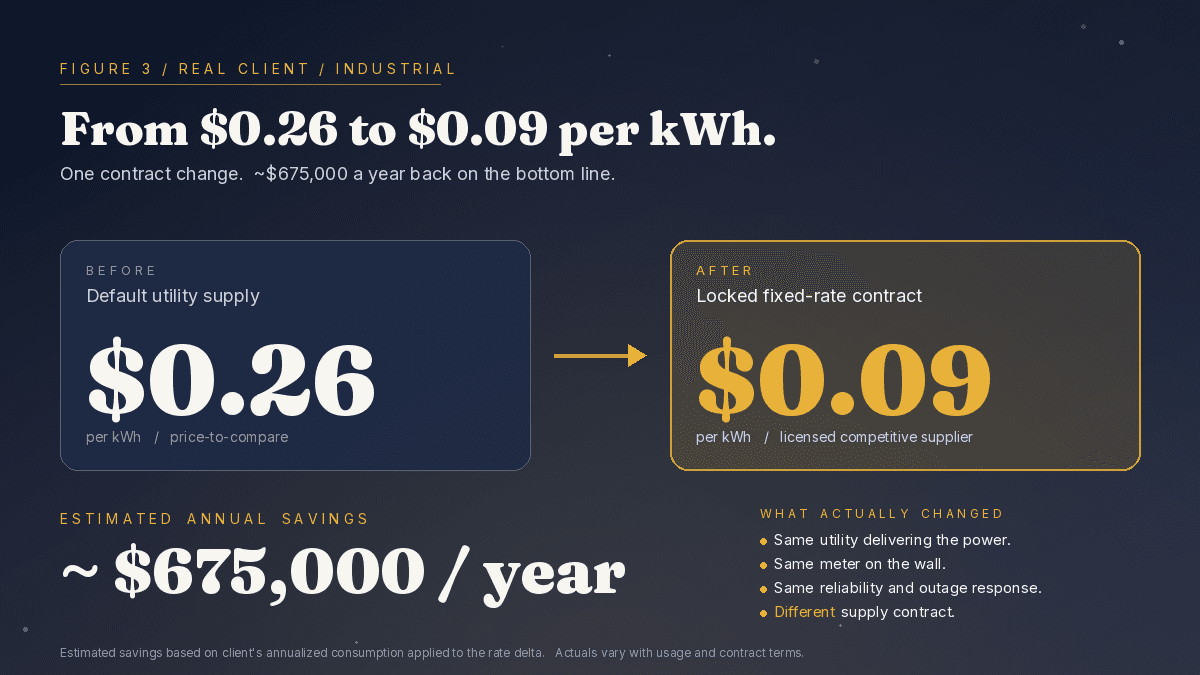
A recent example from our desk. An industrial client was on the local utility's default supply rate at $0.26/kWh. We reviewed twelve months of bills, modelled the load curve against current wholesale forwards, and brought in fixed-rate quotes from licensed competitive suppliers in their state.
The locked contract: $0.09/kWh, fixed for the contract term. Estimated annual savings on the supply portion: approximately $675,000 a year.
To be clear about what changed and what did not. Same utility delivering the power. Same meter on the wall. Same reliability and outage response. Same engineers picking up the phone if something goes wrong.
The only thing that changed was the contract that determines the unit price of the energy itself. The savings did not come from renegotiating with the utility, because the utility does not set the supply rate in a deregulated market. The savings came from buying the supply from someone else.
Figure
One industrial client - default utility supply vs locked fixed-rate contract
How to tell if your business is overpaying
A 10-minute self-check.
Pull your most recent electricity bill. Find the section labelled Supply, Generation, Energy Charge, or Price-to-Compare. The wording varies by utility. Note the rate (in dollars or cents per kWh). Compare it to your state's published default rate and to current competitive offers.
If your rate is the same as the utility's default, your business is buying supply on the most expensive contract in the market. If your rate is from a competitive supplier but the contract was signed more than 24 months ago without re-shopping, there is a high chance the market has moved and a re-quote will save money.
- Step 1 - find the line labelled Supply, Generation, Energy Charge, or Price-to-Compare on your bill.
- Step 2 - note the per-kWh rate (in cents or dollars).
- Step 3 - compare to your state's published default rate (PUCO, PaPowerSwitch, Power-to-Choose, etc.).
- Step 4 - if you are within a few cents of default, you are likely overpaying. Re-quote.
Common misconceptions worth clearing up
My utility offers the best rate because they are the utility. In a deregulated state, the utility is required to make a supply offer, but it is not optimised to be the cheapest one. The utility makes the same per-kWh delivery margin no matter who supplies the power.
Switching suppliers means switching the wires. It does not. The physical infrastructure is owned and operated by the utility. The supplier change is a paperwork change.
It will interrupt my service. No interruption. The transition is invisible at the meter.
There must be a catch - early termination fees, hidden charges. A reputable, state-licensed supplier will give you the contract terms in writing before you sign, and a competent broker will read them before you do. A catch is a sign you are looking at the wrong supplier or the wrong broker.
Our procurement team has this handled. Possibly. But ask them three questions: what is our blended supply rate, when does the contract end, and when did we last re-shop the supply portion? If the answers are vague, the contract is likely renewing on autopilot.
Lock the rate before the next reset.
Seenra runs the supplier shortlist in 5 minutes. No credit pull, no on-site visit, no service interruption. Forever free for households.
Get my fixed-rate quote →Common questions
Quick answers from the editorial desk
Does locking the supply rate insulate my bill from capacity-charge increases?
How does Seenra make money if the service is no-cost to the buyer?
What if wholesale prices fall significantly during my locked term?
Will my service be interrupted when I switch suppliers?
Which states should I shop my commercial supply in?
Sources
- U.S. Energy Information Administration (EIA.gov)
- EIA - Average retail price of electricity by state (commercial)
- PJM Interconnection - Capacity Market (RPM)
- ERCOT - Public Reports
- Public Utilities Commission of Ohio (PUCO) - Apples to Apples
- PaPowerSwitch (Pennsylvania)
- Power to Choose (Texas)
- Federal Energy Regulatory Commission (FERC)